





Botox in Dubai 2026: Types, Innovations, and How to Choose Your Treatment
Botox remains the most requested injectable in aesthetic medicine — and one of the fastest-evolving. Over the past few years the market has added ready-to-use liquid formulas, longer-lasting neuromodulators, and topical peptide alternatives for people who aren't ready for a needle yet. Here's how botulinum therapy actually works, what the different brands are, what's genuinely new in 2026 versus what's just marketing, and which treatment options are available at Refresh Clinic Dubai.
What Botox is and how it works
"Botox" is the everyday name for botulinum toxin type A, though technically it's just one of six brands registered for cosmetic use. Every product in this category shares the same underlying mechanism: the toxin binds to nerve endings and blocks the release of acetylcholine, the neurotransmitter that carries the signal from nerve to muscle.
Mechanism of action
The toxin molecule is made of a heavy chain (~100 kDa) and a light chain (~50 kDa). The light chain is a zinc-dependent metalloprotease that cleaves SNAP-25, a protein in the SNARE complex responsible for fusing synaptic vesicles with the neuron's membrane. Without SNAP-25, acetylcholine-containing vesicles can't release, and the signal to contract the muscle never arrives Visibly, this shows up as a temporary relaxation of the facial muscles — the skin above them smooths out and wrinkles become less noticeable.
How long the effect lasts
According to , the first muscle-weakening effect appears within 2–4 days, with the maximum result forming by day 10. The effect is temporary: the nerve grows new endings, and full neuromuscular transmission returns after roughly 3 months, at which point a repeat treatment is needed. Classic formulations (Botox, Dysport, Xeomin) typically last 3–4 months on average — consistent with what Refresh Clinic Dubai reports for its own patients, where classic botulinum therapy holds for 4–6 months depending on dosage and individual metabolism.
Botox types: how the different brands compare
Seven serotypes of botulinum toxin (A–G) exist, but cosmetic and medical use relies mainly on type A and type B. Today, six type-A injectables and one type-B injectable are officially approved in the US.
| Brand | Active ingredient | Type | What sets it apart |
|---|---|---|---|
| Botox / Botox Cosmetic | onabotulinumtoxinA | A | The "gold standard," with the largest body of clinical data |
| Dysport | abobotulinumtoxinA | A | Spreads faster through tissue; conversion ratio to Botox ≈ 1:2.5–1:5 |
| Xeomin | incobotulinumtoxinA | A | Free of complexing proteins; conversion ratio to Botox ≈ 1:1 |
| Jeuveau | prabotulinumtoxinA | A | Approved for glabellar (frown) lines |
| Daxxify | daxibotulinumtoxinA | A | Long-acting formula — more on this below |
| Letybo | letibotulinumtoxinA | A | A newer market entrant, approved for glabellar lines |
| Myobloc / NeuroBloc | rimabotulinumtoxinB | B | Type B, used mainly in neurology |
Dosing units are not interchangeable between brands — there's no officially agreed conversion factor between products, so dosage is always determined individually by the treating physician .
The classics: Botox, Dysport, Xeomin
These are the three most studied type-A products, backed by more than 30 years of combined clinical data. The differences between them lie in how fast they spread through tissue, how quickly the effect sets in, and molecular structure — not in the underlying mechanism.
The new generation: longer-acting formulas
The biggest recent innovation is longer duration. Daxxify (daxibotulinumtoxinA) became the first neuromodulator to show a median effect duration of 24 weeks (about 6 months) in the SAKURA clinical trials, with some patients seeing results last up to 9 months. That's roughly double the standard 3–4 months and can cut the number of yearly visits to just two.
What's actually new in botulinum therapy for 2025–2026
Amid marketing claims of "revolutionary formulas," it's worth separating what's clinically and regulatorily confirmed from what's still in development.
Ready-to-use liquid formulas
One notable trend is the shift from powder formulations (which need to be reconstituted with saline before injection) to ready-to-use liquid products. A leading example is RelabotulinumtoxinA (brand name Relfydess, developed by Galderma) using PEARL technology: in Phase IIIb trials, some patients saw visible results as early as day 1, with effects lasting up to 6 months (median time to return to baseline: 24–27 weeks). Important caveat: the product is not yet FDA-approved in the US — in February 2026 the agency accepted a resubmitted Biologics License Application (BLA) for glabellar and periorbital lines for review. It's already registered in more than 20 countries, including the EU and UK, though the source doesn't specify exact approval dates in those markets. This is a "pending" status, not "available now" — worth treating as a development to watch rather than a ready offer.
Peptide alternatives: topical "Botox" without a needle
A separate category is cosmetic peptides that mimic part of Botox's mechanism without an injection. The most studied is acetyl hexapeptide-8 (commercial name Argireline): a synthetic peptide that structurally mirrors the N-terminal fragment of SNAP-25 and, in theory, competes with it for a place in the SNARE complex, reducing excessive facial-muscle contraction. In small clinical studies, creams containing acetyl hexapeptide-8 reduced wrinkle depth by an average of 30–49% after several weeks of regular use — a noticeable but far gentler and more gradual effect compared to injectable Botox, which blocks the muscle completely and predictably. These peptide formulas work best as a skincare add-on or a transitional option for people not yet ready for injections, not as a substitute for the treatment when facial wrinkles are already pronounced.
Botulinum therapy at Refresh Clinic Dubai: treatment options
The clinic offers several treatment formats — from classic botulinum therapy to a micro-dosing technique that lowers the risk of a "frozen" look.
Classic botulinum therapy
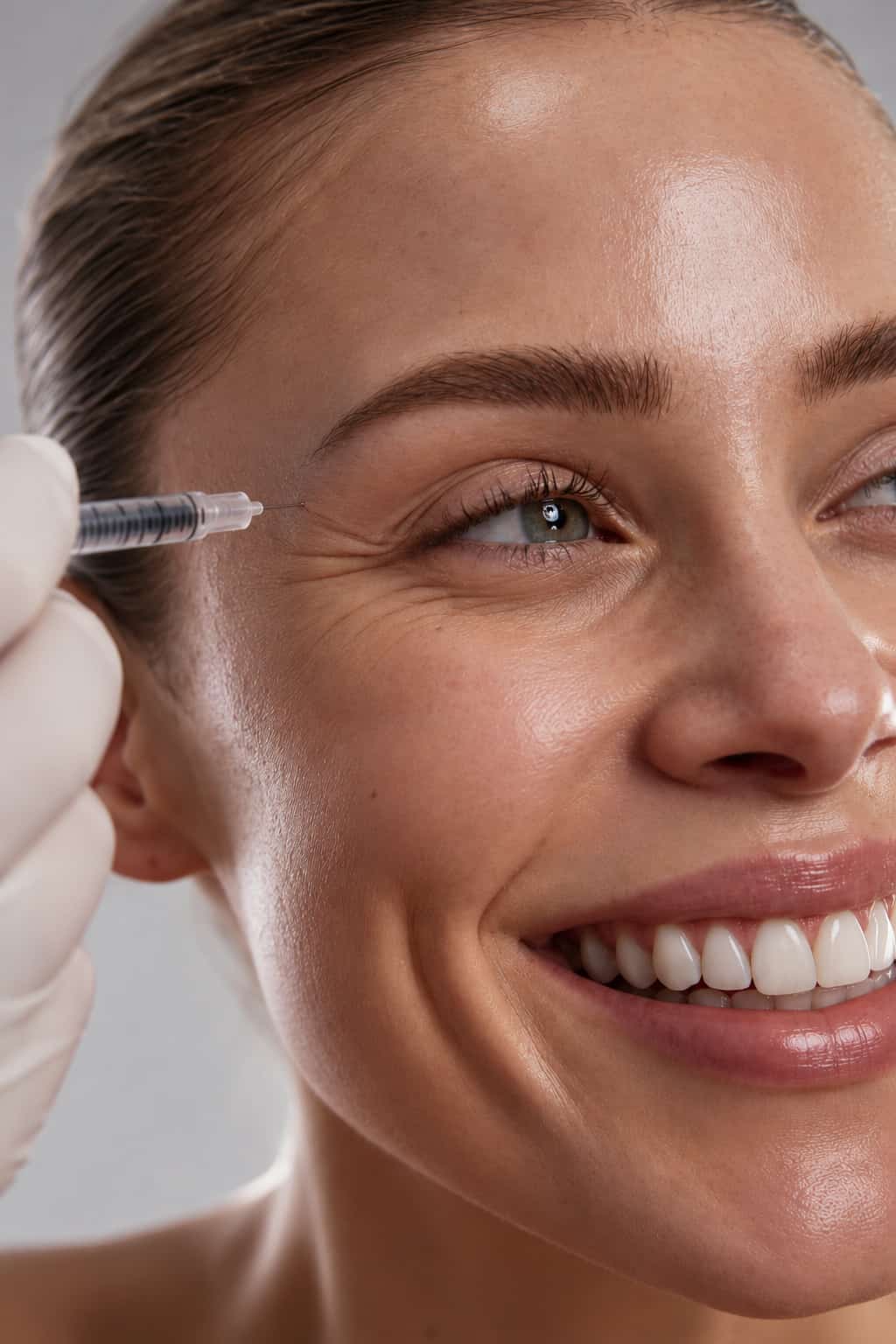
The injection itself takes 15–20 minutes, with no special preparation or downtime required. The doctor assesses facial dynamics and anatomical features, determines an individual dosage, then injects the product into the target muscles with a fine needle. Early improvements appear within a few days, with the full result visible by day 7–10 and the effect lasting 4–6 months
Full-Face Microtoxin Therapy (Baby Botox)
A technique that spreads reduced doses of the product across the whole face, softening lines without fully blocking the muscles. This approach preserves natural expression and particularly suits first-time patients who want to avoid a sudden "frozen" look in the upper third of the face. The clinic directly compares this method with classic botulinum therapy and explains who each option suits best in its own blog pos.
Botulinum therapy for men ("Brotox")
A trend the clinic has been tracking: more men are turning to botulinum therapy to soften forehead and frown lines, which intense expressions and stress tend to deepen faster. The treatment doesn't change masculine facial features and keeps expression natural.
Who the treatment suits
-
Forehead and glabellar (frown) lines
-
Crow's feet around the eyes
-
Lines around the nose and mouth
-
Uneven skin texture, creased areas
-
Signs of tiredness or a tense expression
-
Preventive treatment before pronounced lines develop
-
Hyperhidrosis (excessive sweating) — a medical indication beyond aesthetics
Contraindications and safety
Botulinum therapy has been one of the most studied cosmetic treatments in the world for decades — one clinical review estimates roughly 3 million injections are performed each year, and with correct technique, serious complications are rare; no long-term or life-threatening side effects have been reported for cosmetic use.
That said, the treatment does have clear contraindications:
-
Neuromuscular disorders (including myasthenia gravis)
-
Keloid scarring at the intended injection site
-
Allergy to botulinum toxin or the product's components
-
Body dysmorphic disorder
Pregnancy and breastfeeding are also treated as a general precaution — cosmetic botulinum toxin injections are typically avoided during these periods due to limited safety data, and the final decision always rests with the treating physician after assessing the patient. Possible local side effects include temporary swelling, bruising at the injection site, and upper eyelid ptosis (drooping) if the product diffuses beyond the target area. Risk is minimized through a thorough medical history, correct dosing, sound knowledge of facial muscle anatomy, and an experienced injector.
How to prepare for the treatment in Dubai
Dubai's climate — intense sun exposure, dry air, and sharp temperature swings between the street and air-conditioned interiors — affects how skin reacts and how quickly it recovers after injections. The clinic covers how to adjust your skincare routine and what to watch for before your appointment in a dedicated blog post: “How to Properly Prepare for a Botulinum Toxin Session,” Refresh Clinic Dubai.
FAQ
Is Botox the same as Dysport and Xeomin?
No. All three are type-A botulinum toxin products with the same mechanism of action, but different molecular formulas, tissue-spread rates, and dosing units. Units from different brands don't convert directly into one another — dosage for any given product is always set by the treating physician.
How long does Botox last?
Classic formulations last about 3–4 months on average; at Refresh Clinic Dubai, patients typically see classic botulinum therapy hold for 4–6 months depending on dosage and individual metabolism. Newer-generation products like Daxxify have shown a median duration of around 6 months in clinical trials, with some patients seeing results last up to 9.
What is Baby Botox and how is it different from classic Botox?
It's the Full-Face Microtoxin Therapy technique — reduced doses of the product spread across the whole upper face, gently relaxing muscles without fully blocking them. It suits people who want to keep natural expression and are getting injections for the first time.
Can Botox injections be replaced with a peptide cream?
Cosmetic peptides such as acetyl hexapeptide-8 (Argireline) do partially mimic Botox's mechanism and, in studies, moderately reduce wrinkle depth with regular use. But the effect is gentler and builds up gradually — it isn't a full substitute for the injectable treatment when facial wrinkles are already pronounced.
Are there newer Botox products that last longer?
Yes. Daxxify is already approved and shows effects lasting 6–9 months. Another product, RelabotulinumtoxinA (Relfydess), is going through FDA review (its application was accepted for review in February 2026) and is already registered in a number of countries outside the US — in clinical trials it showed a faster onset and comparable duration.
Is Botox suitable for men too?
Yes, and it's a growing trend that Refresh Clinic Dubai refers to as "Brotox." The treatment softens forehead and glabellar lines without changing masculine facial features.
Are there contraindications to Botox?
Yes: neuromuscular disorders, keloid scarring at the injection site, allergy to the product, body dysmorphic disorder, and pregnancy or breastfeeding. The final decision is made by the physician after a consultation and assessment.
How much does Botox cost in Dubai at Refresh Clinic?
Price depends on the area and number of units — from 30 AED per unit for targeted correction up to 3,000 AED for a combined face/neck treatment. Full-Face Microtoxin Therapy (Baby Botox) costs 800 AED.
This article is for informational purposes only and does not replace a medical consultation. Decisions about whether to undergo treatment, and which product and dosage to use, are made individually during an in-person consultation, taking medical history and contraindications into account.
Related services