










Thyroid Dysfunction: Hypothyroidism and Hyperthyroidism
The thyroid is a small, butterfly-shaped gland at the front of the neck, but its influence reaches virtually every cell in the body. It produces the hormones thyroxine (T4) and triiodothyronine (T3), which regulate metabolic rate, body temperature, heart function, and protein synthesis. When the balance of these hormones is disrupted — toward deficiency (hypothyroidism) or excess (hyperthyroidism) — weight, energy, mood, heart rhythm, menstrual cycles, and fertility can all be affected.
Estimates put overall thyroid disease prevalence at 1–4% of the population, while subclinical hypothyroidism — a borderline state — affects 4.3% of people aged 12 and older in the US, and is especially common in women over 55. Here's how the thyroid works, how hypothyroidism and hyperthyroidism differ, which symptoms warrant a doctor's visit, and how diagnosis works.
How the Thyroid and Its Hormones — TSH, T3, T4 — Work
The thyroid works in tandem with the pituitary gland, located at the base of the brain, which releases thyroid-stimulating hormone (TSH). TSH "instructs" the thyroid to produce more or less T4 and T3 depending on the body's needs.
This system operates on a feedback loop:
-
When T4/T3 levels are too low, the pituitary raises TSH to push the gland to work harder (the typical pattern in hypothyroidism).
-
When T4/T3 levels are too high, the pituitary lowers TSH, often below the detection threshold (the typical pattern in hyperthyroidism).
That's why the TSH test is considered the most sensitive frontline screening tool for thyroid function: even modest hormone changes trigger marked TSH swings. The standard adult reference range for TSH typically falls between 0.4–4.0 mU/L, and values outside this range call for further evaluation with free T4 and T3.
Why the Thyroid Falls Out of Balance
One of the leading causes is iodine deficiency — the thyroid needs iodine to synthesize T4 and T3. In regions with low iodine intake, this remains the primary cause of hypothyroidism worldwide, although salt iodization has made the problem far less common in many countries. In iodine-sufficient regions, including most developed countries, autoimmune processes become the dominant cause — the immune system mistakenly produces antibodies that attack the thyroid gland itself.
Hypothyroidism: When the Thyroid Is Underactive
Hypothyroidism develops when the thyroid produces too little hormone, slowing the body's metabolism overall.
Causes of Hypothyroidism
-
Hashimoto's thyroiditis — the most common cause of hypothyroidism in iodine-sufficient regions. The immune system produces antibodies that attack thyroid tissue.
-
Iodine deficiency — the leading cause of hypothyroidism worldwide in regions with insufficient intake.
-
Aftereffects of treating hyperthyroidism with radioactive iodine or thyroid surgery: permanent hypothyroidism develops in 80–90% of patients following radioiodine treatment for Graves' disease, typically within 8–20 weeks.
- Thyroiditis (thyroid inflammation), including postpartum thyroiditis, which affects nearly 10% of women, usually 8–20 weeks after delivery.
- Certain medications — lithium, amiodarone, and several other drugs can suppress thyroid function.
- Congenital disorders and pituitary conditions — rarer causes, including insufficient TSH production by the pituitary gland.
Symptoms of Hypothyroidism
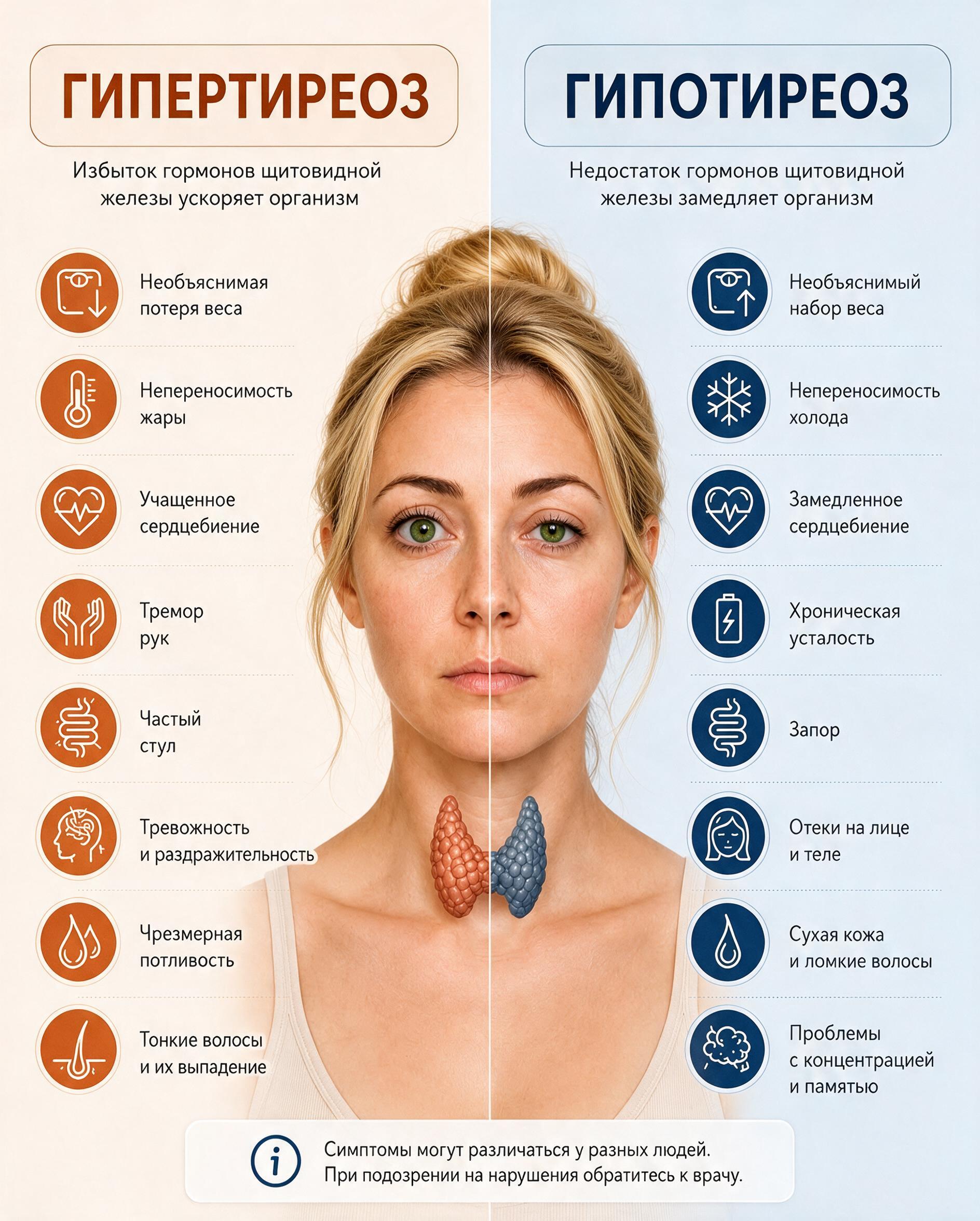
Symptoms typically develop slowly, sometimes over years, and in the early stages are easy to mistake for ordinary fatigue or aging:
-
Persistent tiredness and weakness
-
Increased sensitivity to cold
-
Unexplained weight gain
-
Dry skin, brittle hair, and hair loss
-
Constipation
-
Puffy face, hoarse voice
-
Muscle aches and stiffness
-
Heavy or irregular menstrual periods
-
Slowed heart rate (bradycardia)
-
Depression, reduced concentration and memory
-
Fluid retention, elevated cholesterol
Left untreated, hypothyroidism can lead to goiter, cardiovascular complications, higher "bad" LDL cholesterol, reduced fertility, and — in rare severe cases — life-threatening myxedema coma.
Subclinical Hypothyroidism
A separate category is subclinical (hidden) hypothyroidism — a state where TSH is already elevated but T4 and T3 remain within normal range, often with no obvious symptoms. This affects 4–10% of people depending on age and sex, and requires a confirmatory repeat test before any treatment decision. Patients with positive thyroid peroxidase (TPO) antibodies face a higher risk of progressing to overt hypothyroidism — up to 50% within 20 years of follow-up.
Hyperthyroidism: When the Thyroid Is Overactive
Hyperthyroidism (thyrotoxicosis) is the opposite state, in which the thyroid produces excess hormone and metabolism speeds up.
Causes of Hyperthyroidism
-
Graves' disease — an autoimmune condition in which the body produces antibodies (thyroid-stimulating immunoglobulin) that mimic TSH and push the gland into overdrive. It is the most common cause of hyperthyroidism, responsible for 60–80% of all cases. Overall hyperthyroidism prevalence in the US is estimated at 1.2%, with a lifetime risk of Graves' disease of about 3% in women and 0.5% in men.
-
Toxic multinodular goiter and toxic adenoma — thyroid nodules that autonomously produce hormone.
-
Thyroiditis — inflammation that temporarily releases stored hormone into the bloodstream, after which the gland may shift into hypothyroidism.
-
Triggers for Graves' disease: stress, smoking, infection, excess iodine, pregnancy (particularly the postpartum period).
Symptoms of Hyperthyroidism
The classic presentation in patients under 60 includes:
-
Heat intolerance, excessive sweating
-
Rapid heartbeat, sometimes arrhythmia
-
Unintentional weight loss despite increased appetite
-
Hand tremor, anxiety, irritability, insomnia
-
Frequent bowel movements
-
Muscle weakness
-
Menstrual irregularities, reduced libido
-
A sense of neck discomfort or swelling (goiter)
-
With Graves' disease specifically — characteristic eye symptoms: eyelid swelling, redness, bulging eyes (exophthalmos), double vision
In patients over 60, symptoms are often subtle and may masquerade as ordinary fatigue or weight loss; sometimes the first sign is new-onset atrial fibrillation — a pattern known as "apathetic thyrotoxicosis".
Left untreated, hyperthyroidism raises the risk of thyroid storm, atrial fibrillation, high-output heart failure, and osteoporosis.
Who's at Risk
Based on clinical data, it's worth seeing an endocrinologist for a thyroid function evaluation if you have any of the following:
-
Female sex and age over 60 (for hypothyroidism) or 20–50 (for Graves' disease)
-
A family history of thyroid disease or other autoimmune conditions
-
Type 1 diabetes, celiac disease, or other autoimmune conditions
-
Pregnancy planning, pregnancy, or the postpartum period
-
A prior history of hyperthyroidism treatment, thyroid surgery, or neck irradiation
-
Smoking (particularly relevant to Graves' disease and eye disease)
The American Thyroid Association suggests thyroid function screening every 5 years starting at age 35, though there are no universal mandatory guidelines for population-wide screening.
Diagnosis: What Tests Reveal Thyroid Status
The TSH test remains the primary and most informative first step. If it falls outside normal range, free T4 and free T3 are ordered to clarify the picture:
| Result | Interpretation |
|---|---|
| High TSH + low free T4 | Overt hypothyroidism |
| High TSH + normal free T4 | Subclinical hypothyroidism |
| Low TSH + high free T4/T3 | Overt hyperthyroidism |
| Low TSH + normal free T4/T3 | Subclinical hyperthyroidism |
When an autoimmune cause is suspected, thyroid peroxidase antibodies (TPOAb) are added, and, if needed, TSH receptor antibodies (to help confirm Graves' disease) — modern TSH-receptor antibody assays reach 97% sensitivity and 99% specificity. Thyroid ultrasound is used when nodules or gland enlargement are suspected, but it is not a routine requirement.
At Refresh Clinic Dubai, thyroid function can be assessed with the dedicated Thyroid Function Test check-up (TSH, free T3, free T4), and for women whose symptoms may involve the menstrual cycle or fertility, the more comprehensive Hormonal Profile (Female) check-up, which covers key pituitary, thyroid, and sex hormones. The full list of available lab check-ups and pricing is on the Check-up: full body health examination page, with current pricing on the check-up pricing page.
Treatment and Support Approaches
It's important to understand: hypothyroidism and hyperthyroidism are diagnoses confirmed only by laboratory testing, and they require the prescription and ongoing supervision of an endocrinologist. No symptom on its own confirms a diagnosis, and self-directed correction without testing and consultation can be dangerous.
For hypothyroidism, the standard of care is hormone replacement therapy with levothyroxine, a synthetic form of T4, taken daily on an empty stomach; the dose is individualized and monitored with repeat TSH testing every 6–8 weeks until a stable result is reached.
For hyperthyroidism, doctors choose among three main approaches — antithyroid medication (methimazole or propylthiouracil), radioactive iodine therapy, or surgical removal of the thyroid — with the choice depending on age, disease severity, pregnancy plans, and patient preference.
The clinic's specialized services do not replace treatment of the underlying condition prescribed by an endocrinologist, but they can support diagnosis and recovery as part of a broader care plan:
-
Endocrinologist consultation at Refresh Clinic Dubai — to interpret lab results, guide monitoring, or arrange further treatment; consultations are available with the endocrinology team.
-
Scheduled check-ups to track TSH, T3, and T4 trends over time.
-
IV drips to support energy and overall wellbeing (for example, the energy and vitality IV line) — as a supportive measure for fatigue associated with hypothyroidism, not a substitute for hormone therapy.
-
Gynecology consultation with ultrasound, part of Refresh Clinic Dubai's gynecology services — relevant for menstrual irregularities or pregnancy planning, since thyroid function directly affects reproductive health.
-
For hair thinning associated with hypothyroidism, a doctor may separately assess follicle health — see the clinic's hair restoration service.
Note as well: the clinic's weight-management and metabolic programs (including weight-loss IV drips and peptide therapy) are designed for patients with normal thyroid function, or for those whose underlying condition is already under an endocrinologist's control — they are not intended to treat hypothyroidism or hyperthyroidism itself.
Frequently Asked Questions (FAQ)
Can hypothyroidism or hyperthyroidism be diagnosed from symptoms alone, without testing?
No. Symptoms of both conditions (fatigue, weight changes, mood changes) are nonspecific and overlap with many other conditions. An accurate diagnosis requires blood testing for TSH, free T3, and free T4, with antibody testing added when needed.
What is subclinical hypothyroidism, and does it need treatment?
It's a state of elevated TSH with normal T3 and T4, often without noticeable symptoms. Treatment decisions are individualized, weighing age, TSH level, symptoms, TPO antibody status, and pregnancy plans. A mildly elevated TSH is confirmed with a repeat test before starting therapy.
How often should the thyroid be checked if there are no symptoms?
Without risk factors, universal screening isn't considered mandatory, but the American Thyroid Association suggests roughly every 5 years starting at age 35; with a family history of thyroid disease, autoimmune conditions, or pregnancy planning, more frequent testing on a doctor's recommendation is advisable.
Does the thyroid affect weight, and can treating it alone lead to weight loss?
Hypothyroidism can contribute to weight gain by slowing metabolism, and some of this effect typically eases once adequate replacement therapy is underway. However, the thyroid is only one factor in body weight, and hormone correction does not replace a comprehensive approach to nutrition and metabolism.
Can thyroid dysfunction affect the ability to have children?
Yes. Both hypothyroidism and hyperthyroidism can disrupt ovulation and the menstrual cycle, reducing fertility; during pregnancy, untreated thyroid dysfunction raises the risk of complications for both mother and baby, which is why thyroid function should be monitored before and during pregnancy.
This material is provided for informational purposes and does not replace medical advice. Diagnosis and treatment of hypothyroidism and hyperthyroidism are based only on laboratory testing and are prescribed by an endocrinologist.