






The Peptide Revolution: A Short History, the Science, and Smart Ways to Combine Them
A hundred years ago, peptides were an experimental extract pulled from a dog's pancreas. Today they're one of the fastest-moving fields in medicine, touching everything from diabetes care to biohacking, skin rejuvenation, and weight management. The peptide drug market keeps posting double-digit growth year after year, and personalized-medicine clinics — Refresh Clinic Dubai among them — now build entire protocols for recovery, metabolic reset, and anti-aging around them. Here's how it all started, and, more usefully, what peptides actually pair well with.
What peptides are, and why "revolution" isn't an exaggeration
Peptides are short chains of amino acids that the body already uses as messengers — signals that switch on, dial up, or shut down specific processes: tissue repair, hormone release, inflammation, collagen production. Unlike the small synthetic molecules classic pharmacology relies on, peptides tend to mirror signals the body already produces on its own. That's part of why they can act with more precision and fewer surprises.
Three things set peptides apart:
-
Precision. A single peptide can target one receptor without creating noise across the rest of the body.
-
They work with your data. Doses and combinations are chosen based on actual bloodwork, not guesswork.
-
They stack well. Peptides combine cleanly with each other and with other therapies — IV drips, device-based treatments — often amplifying the overall result.
A short history of peptides: from 1921 insulin to today's protocols
Insulin: the first peptide drug (1921–1922)
Most histories of peptide medicine start in 1921, when Frederick Banting and Charles Best at the University of Toronto isolated insulin from a dog's pancreas. By January 1922, 14-year-old Leonard Thompson received the first insulin injection ever given to a patient — turning what had been a death sentence into a manageable condition (peptides.com; uaepeptides.com). It wasn't just a new drug. It was proof that a short protein fragment could be pulled out of living tissue and used to treat people at scale.
Oxytocin and the first lab-made peptide (1953–1963)
The next big leap came in 1953, when biochemist Vincent du Vigneaud synthesized oxytocin — the first peptide hormone ever built from scratch in a lab rather than extracted from tissue. He won the 1955 Nobel Prize in Chemistry for it (peptides.com). The breakthrough mattered because it proved something fundamental: a peptide's activity comes down to its exact sequence of amino acids, not some property unique to living cells. Once that was clear, peptides became something scientists could actually design. Ten years later, in 1963, Bruce Merrifield introduced solid-phase peptide synthesis — a method that made producing peptides fast and scalable, and one that later earned its own Nobel Prize (Muttenthaler et al., Nature Reviews Drug Discovery).
The recombinant-DNA and GLP-1 era (1980s–2020s)
In 1982, recombinant human insulin (Humulin) hit the market — the first drug ever made with recombinant DNA technology. Synthetic hormone analogs followed soon after, including leuprolide (1985) and goserelin (1989) (Muttenthaler et al.). Meanwhile, GLP-1 receptors were discovered in the 1980s — a finding that eventually led to exenatide in 2005, and later to semaglutide and tirzepatide, drugs that rewrote how type 2 diabetes and obesity are treated.
Where we are now: personalized, diagnostics-driven protocols
The "peptide revolution" people talk about today isn't tied to a single discovery — it's a shift in how peptides are used. They've moved from narrow prescription drugs to a genuine tool of personalized medicine. Regenerative peptides like BPC-157 and TB-500, longevity peptides like Epitalon, growth-hormone secretagogues like CJC-1295 and Ipamorelin, and newer metabolic peptides like retatrutide and cagrilintide are now combined into protocols built around each patient's own diagnostics — which is exactly how the Refresh Clinic Dubai peptide catalog is organized.
What to combine peptides with: the logic behind smart stacking
The question patients ask most often isn't "which peptide should I take" — it's "what can I combine it with." A good combination (peptide stacking, if you've come across the term) isn't about piling names on top of each other. It works because each peptide does its job at a different stage of recovery, so the body isn't getting conflicting signals at once.
Regeneration: GHK-Cu, BPC-157, and TB-500
One of the best-known combinations pairs GHK-Cu with BPC-157 and TB-500. GHK-Cu wakes up fibroblasts and drives collagen synthesis, BPC-157 brings cytoprotective, regenerative support, and TB-500 helps cells migrate to the site of injury — so healing happens in an organized way rather than chaotically, with less risk of dense scarring. The mechanics of this trio are broken down in Combination of Peptides GHK-Cu, BPC-157, and TB-500. It's also the basis for the ready-made Glow Peptide complex, available in an easy pre-filled Glow Pen.
Growth hormone: CJC-1295 and Ipamorelin
CJC-1295 nudges the pituitary gland into releasing growth hormone and IGF-1 in natural pulses, while Ipamorelin boosts that effect without raising cortisol. That's why the two are almost always used together rather than on their own — the pair gets you a stronger, more physiological GH response than either peptide alone. More on how it works and the formats available on the CJC-1295 Pen page.
Peptides plus IV therapy: getting more out of both
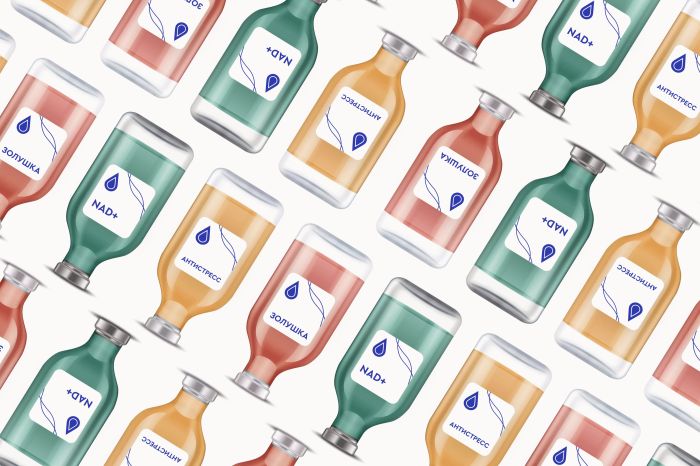
Peptides also pair well with IV drips. Delivering a peptide alongside vitamins, minerals, and antioxidants in the same infusion boosts bioavailability and lets one session cover several goals — energy, recovery, skin quality, metabolism — instead of just one. That's the idea behind the Refresh IV drip, part of the clinic's broader IV drip lineup.
Training and recovery: what athletes tend to combine
People training hard get the most out of combinations built around tissue repair, joint support, and energy. There's a deeper look at which peptides and combinations show up in sports-focused protocols in Advanced Peptide Therapy for Athletes: Optimizing Recovery, Endurance, and Performance.
The real starting point: a check-up, not a shopping list
No solid protocol starts with picking peptides off a list — it starts with data. Before any combination gets designed, a physician looks at your hormonal, metabolic, and biochemical profile through check-up programs, including the more extensive Check-up Classic. That's what rules out contraindications and gets doses right for you specifically, instead of copying a generic stack you saw online.
Peptide protocols and services at Refresh Clinic Dubai
At Refresh Clinic Dubai, peptide therapy is never a standalone add-on — it's built into a three-step approach:
-
Testing first. Check-up programs and hormone panels show which combinations actually make sense for your body.
-
Choosing the protocol. The peptide catalog covers everything from individual peptides to ready-made formulas — the regenerative Glow complex, growth-hormone support via CJC-1295, and more.
-
Putting it all together. Peptide protocols get paired with IV drips and structured metabolic programs from the Programmes section.
Safety and contraindications
Peptides aren't a supplement you pick up without a second thought — they're a therapy that needs medical oversight. Even peptides with solid research behind them can cause problems if the dose is off, they're combined with the wrong substance, or an underlying condition isn't accounted for. Any combination should come from a physician working off your actual lab results, not advice from social media — which is the standard every protocol follows at Refresh Clinic Dubai.
FAQ: peptides, answered
What was the first peptide ever used in medicine?
Insulin. Frederick Banting and Charles Best isolated it from animal pancreatic tissue in 1921, making it the first peptide with a real therapeutic use (peptides.com).
Can you combine peptides with each other?
Yes — plenty of peptides are specifically designed to be used together. GHK-Cu with BPC-157 and TB-500 for tissue regeneration, or CJC-1295 with Ipamorelin for a stronger growth-hormone response, are two common examples. Any combination should still be built by a physician around your goals and lab results, not assembled on your own.
What shouldn't peptides be combined with?
There's no single blanket rule — it depends on the specific peptides, the dose, and your health history. That's exactly why every protocol at Refresh Clinic Dubai starts with a check-up rather than a self-designed combination.
Do I need blood work before starting peptide therapy?
Yes. A hormonal and biochemical profile is what lets a doctor rule out contraindications and land on the right dose for you — it's standard practice before any peptide protocol at the clinic.
How do peptides work alongside IV drips?
They're often delivered together — a peptide plus vitamins, amino acids, and antioxidants in the same infusion, which improves bioavailability and lets one session tackle several goals at once, like energy and skin quality together. The Refresh IV drip is a good example of how that's structured.
External sources (fact-checked history)